

Why Does Genesis 1-11 Matter?

Maybe you have heard someone at church say this or during a conversation “Genesis 1-11 really does not need to be a focus”, “The Flood account is not significant” or “compared to the rest of the Bible, the first few chapters of Genesis make up only a fraction of the vastness of the overall Bible, God is more concerned with our relationship with Him.”
So, the question is, why do the early chapters of the Book of Gensis matter?
The Creation and The Fall Matter
Creation & Fall accounts are two major church theology pillars. The church where I have been a member for years uses a visual aid to help understand and learn the significance of these pillars and how God’s story is the foundation of a Christian worldview.

Without a literal Fall and literal sin, there is no need for the third pillar: Redemption.
If the first two pillars (Creation & Fall) are merely metaphors/allegories (did not literally happen in human history) does that then suggest the fourth pillar (The New Heavens & New Earth) should be understood as metaphorical too? What hope does the Christian have in this life, at the end Judgement and for the reality of eternity? There is a slippery slope when the concept of metaphor slips into Biblical theology. That said, there are very obvious usages of visual metaphors used such as when Jesus refers to himself as “a door” (John 10:7-9), and in John 15:5 when Jesus says “I am the vine.” Readers know the Lord is clearly speaking metaphorically.
In The Beginning God
Islam’s creation account has so many similarities to the Genesis creation account, that the Koran which was composed hundreds years after the biblical canon, looks to have received many of its principles from the biblical account. In Hinduism there are multiple gods that play a role in the creation account which has no definitive beginning. In fact, the Hindu account is less about an actual creation beginning/event and is more focused on an on-going process of creation. In Buddhism, there is no specific focus on a creator god or a definitive creation event of the universe. Buddhism teaches of endless creations and destructions in an on-going cycle. The Creation account in Genesis and echoed throughout Scripture is truly unique i.e. PS 19, PS 33:6, JOB 12:7-10, ISA 40:26, ROM 1:20.
Until the 1920’s only the Christians, Jews and Muslims believed in a clear beginning. Prior to this time, the universe was thought to be eternal, timeless, there was no beginning or end. This philosophy traced all the way back to Aristotle, a Greek pagan who could not image the limited gods of his time having the vastness, the omnipotence to create the entire universe. Those that were students of Biblical history the early chapters of Genesis knew better. This was in fact a beginning as clearly stated in the very first verse of Genesis “In the beginning God created the heavens and the Earth.” Universe derived from the Latin is “one verse.”
The Creation Week Chronology
The Creation week chronological account verse the Nebular hypothesis chronology is very different. Notice below, in example after example, there is a stark difference in the views of how creation was started.
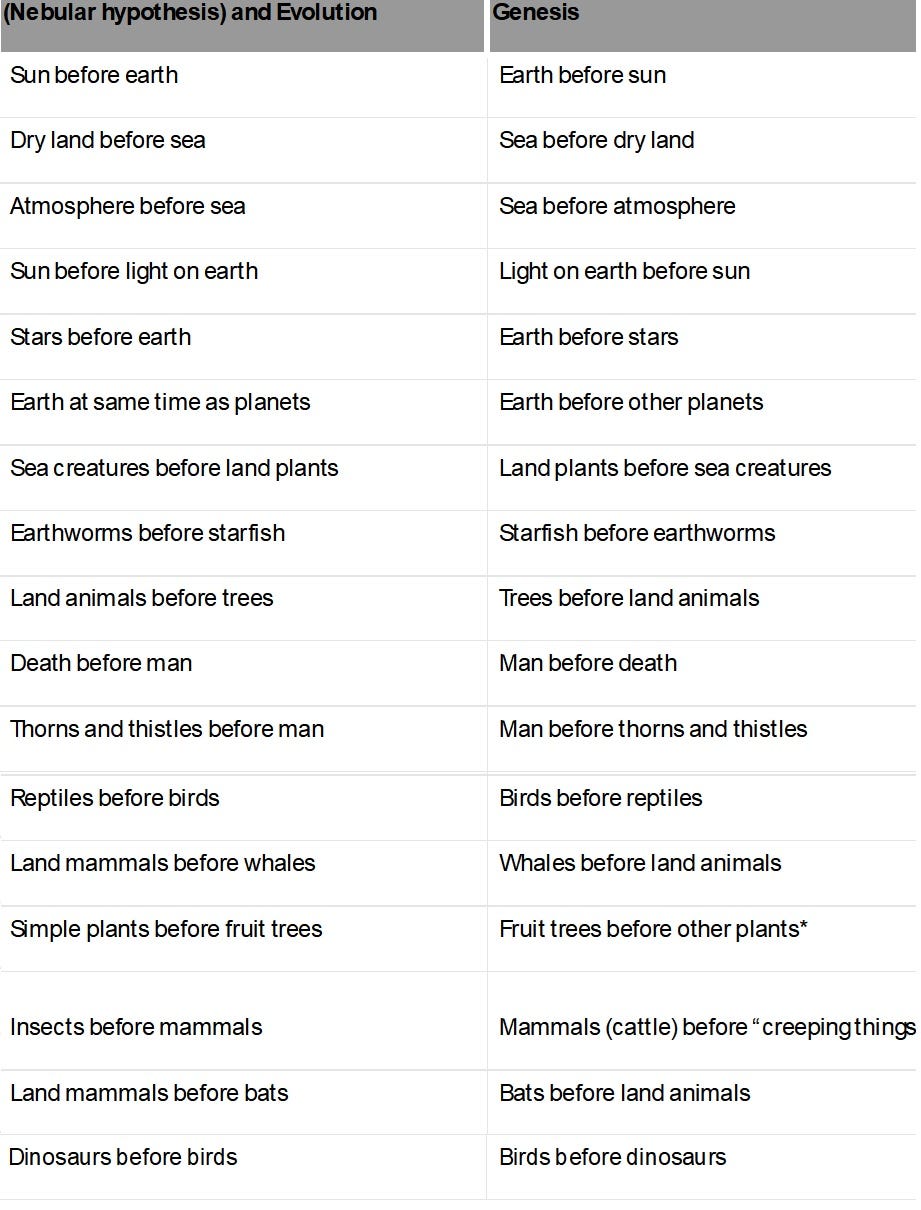
This essay is not focused on issues such as the age of the Earth or the problems of evolutionary biology. For more specific information on each of those matters please see:
The Age of the Earth: YouTube Talk
Biology, Darwin and the Bible: YouTube Video Series
Additional Anchor-points of Theology First Found in Genesis
The first examples of God’s character: The Creator (genius, majesty and power), grace, mercy, sacrificial, holy, has built humans for relationship with Him. He is faithful (see the first promise of God in GEN 3:15 which is later fulfilled in Christ).
The bloodline of Christ to Adam in GEN 5 & 10 genealogies (which Luke traces through Mary’s biological linage and Matthew traces Joseph’s legal linage to Abraham).
The first marriage which defines our understanding marriage. The first example of worship, ethics and morality with the offerings of Abel by Cain and then the murder of Able in GEN 4. God used this event as an example that not only was murder categorically wrong, but there were consequences (which was a continuation from Cain’s parents’ rebellion in GEN 3).
Doctrine Matters
The following descriptions of major Christian doctrines come (directly quoted unless otherwise [noted in brackets]) from The 99 Essential Doctrines, published by the Gospel Project in 2018. 99-Essentials-Booklet.pdf
Each of the following doctrines are anchored in the early chapters of Genesis.
Doctrines of God’s Character:
The doctrine of God is Infinite: Meaning there are no boundaries on His qualities and existence (JOB 11:7-9, Ps 147:5). For instance, God is infinite when it comes to space and time, meaning He is not confined by material space nor is He restricted by time since He is timeless (Ps 90:1-2). God’s infinity also extends to His knowledge of things as well as His power to do all things according to His will. [God is infinite is first showcased in Genesis chapter 1].
The doctrine of God is Omniscient: Scripture teaches that God is all-knowing. He is the One who has perfect knowledge (JOB 37:16), and this knowledge extends to all things past, present and future. His knowledge is complete. In response to God’s omniscience, we admit our finite knowledge and trust His decisions as wise and good. [God is omniscient is first highlighted in Genesis chapter 1].
The doctrine of God is Omnipotent: God is all-powerful, there is nothing God cannot do so long as it does not contradict His own nature or law. God has power and authority over the universe. He created, from the largest solar system to the smallest particle. As Christians, we rest in the belief that the God who has all power is good, and we gain great comfort by knowing that an all-powerful God is working for our good and joy. [God is omnipotent is first established in Genesis chapter 1].
The doctrine of God is Transcendent: God’s transcendence refers to the fact that He is distinct from and independent of His created world. He is transcendent over us in regard to His greatness and power as well as His goodness and purity. The implication of this doctrine is that God is inherently superior to humanity. His thoughts and ways are higher than ours (Isa 55:8-9). Understanding God’s transcendence evokes awe and wonder at His goodness and power. [God is transcendent is first showcased in Genesis chapter 1].
The doctrine of God is Immanent: When we say that God is immanent, we mean that God is personable and relatable to those made in His image, while remaining completely distinct and unique from all of His creation. It means God is not a distant deity (as imaged by the deists), but instead, He is a personal God who created people in His image to be in personal relationship with him. [God is immanent is first highlighted in Genesis chapter 2].
Doctrines of The Creation: (70 times Bible refers to God as creator)
The doctrine of Creation out of nothing: The Bible teaches that God created the universe—both visible and invisible—out of nothing (sometimes expressed in the Latin phrase “creation ex nihilo”). This means that before God created anything, nothing else existed except God himself. God alone is eternal; every created thing has a beginning. Therefore, the eternal God rules over all of His creation and He alone is worthy of worship. [GEN 1:1 “In the beginning God created the heavens and Earth,” this is God’s universe. Denial of this doctrine has implications for God’s sovereignty over and providence in creation]. Because God created out of nothing, creation has meaning and purpose and points us to the Creator. [Creation out of nothing is first showcased in Genesis chapter 1].
The doctrine of The Goodness of Creation: In GEN 1, God repeatedly affirmed that all of His creation was good, even “very good.” It is good, in God’s judgement, because He created it for a purpose that it fulfilled—to reflect and display the good character of the Creator. Therefore, sin and evil should not be seen as a foundational part of the creation but rather as a corruption of it. [The goodness of creation is first highlighted in Genesis chapter 1].
The doctrine of God’s Glory: The glory of God is His manifest work, the way He represents His perfect character through His activity. It also refers to His excellent reputation and is given as one of the reasons we are to praise His name. Another sense of the word is the inherent beauty of God, the unbearable brightness and beauty of His being as He radiates His own attributes and characteristics for all to witness. [God’s glory is first established in Genesis chapter 1].
The doctrine of Image of God in Humanity: The image of God in humanity is understood as mirroring God’s attributes in our nature, and relational capacities. In Jesus, we see the true image of God. He perfectly mirrors God’s attributes, fulfills God’s will, and enjoys a perfect relationship with the Father. The Bibe continues to speak of the image of God in humanity even after our fall into sin, even though our ability to rightly reflect God has been marred.
[This brings into question a more recent philosophy that humans evolved from apes. To many Christians this concept is an abomination and blasphemy, especially when viewed through the doctrine of humanity being created in God’s image. I have a one hour talk on this specific subject looking at the paleoanthropology and what the science and data actually show: YouTube talk: Apes or Man? Made in the image of God is first showcased in Genesis chapter 1].
The doctrine of God’s Plan and Human Action: God’s sovereignty over all of life encompasses the free actions of human beings. In many ways we are unable to comprehend fully, the Lord’s plan goes forward through the choices of human beings as moral agents. Even freely chosen sinful actions are factored into God’s overarching plan, as is the case with the crucifixion of Jesus—an event both purposed by God through foreknowledge and yet also carried out by the wicked decisions of human beings. [God’s plan and human action is first highlighted in Genesis chapter 3].
The doctrine of God’s Providence: Providence refers to God’s continuing work and involvement in His creation. This includes, in various degrees, God’s preservation of the created order. His governance, and His care for His people (see GEN 8:21-22). Christians believe the world, and even the cosmos itself, is contingent upon God, incapable of existing apart from Him. Christians also believe in God’s personal and direct intervention in the world—as opposed to the hands-off approach to creation—that affects not only the natural order but also the individuals and events within human history. [God’s providence first established in Genesis chapter 1].
The doctrine of The Problem of Evil: Many atheists have argued that if God is all-powerful, all-loving, and knows everything, then evil would not exist in the world as humans know it today. But because evil exists in the world, God must not exist (or if He does exist, the He is not good or all-powerful). Despite it’s powerful rhetoric, appealing to evil as an argument against God fails: first, because outrage over bad things in this world presupposes a “good” moral standard that does not exist apart from God, and second, because God could have a good reason (though unknown to us) for allowing evil and suffering to continue for a season. Additionally, the atheist arguing for the presence of evil suggests the belief in a super-natural agent and in the argument is also presupposing the agency of God is real too! [The problem of evil is first showcased in Genesis chapter 3].
[Adam and Eve were given free will, they had choice and freely chose to reject God’s rule and discarded the direction of the Creator. God did not create humans as robots (he could have, but he did not because every human has the power to choose, has volition. God knew that as robots, humans would be unable to experience love, worship, redemption, beauty and most of all would not be able to freely chose to follow, love and honor God freely. Free will gave humanity a tremendous opportunity and responsibility but also opened the possibility to recklessly disregard God’s command(s), love and reality].
The doctrine of Miracles: A miracle is an event which God makes and exception to the natural order of things, or supersedes natural laws, for the purpose of demonstrating His glory and/or validating His message. Miracles are recorded throughout Scripture. Because we believe God to be all-powerful and personally involved in this world, we believe He can and does perform miracles. [Dr. Frank Turek has often argued the greatest miracle ever performed by God was The Creation, for without that single miraculous event, nothing else (even future miracles such as the resurrection would not be able to exist). Miracles are first highlighted in Genesis chapter 1].
Additional biblical doctrines rooted in the early chapters of Genesis:
The doctrine of Dominion: In biblical terms, dominion refers to the authority and responsibility God grants humanity to govern, manage, and steward His creation as His representatives. It is rooted in Genesis 1:26–28, where God creates humans in His image and commands them to “have dominion over the fish of the sea and over the birds of the air and over every living thing that moves on the earth.”
The doctrine of Created kinds: The doctrine of theology that holds that God created life in a finite number of distinct, genealogically separate groups—called kinds—during the Genesis creation week. Genesis 1:11–24 is where God commands plants, animals, and humans to reproduce “after their kind,” meaning each original kind was distinct and separate from others. For additional specifics of this doctrine and how it relates to biology, I have a talk that goes into much further detail: Whales, Horses, Birds, Ethics and more!
The doctrine of be fruitful and multiply: In Genesis 1:28, God commands Adam and Eve: “Be fruitful and multiply and fill the earth and subdue it; rule over the fish of the sea and the birds of the air and every creature that crawls upon the earth.” It is repeated to Noah and his family after the Flood (Genesis 9:1–7), showing its enduring relevance. God’s command is tied to His blessing for humanity to populate the earth He created (Isaiah 45:18). Fruitfulness is not just about procreation; it also involves caring for creation, managing resources, and cultivating healthy relationships.
The doctrine of the first and last Adam: The doctrine contrasts the first human, Adam, with Jesus Christ, the “last Adam,” to explain the origin of sin and death and the basis of salvation. In Genesis 1–3, God created Adam as the first image bearer—a human made in His likeness, placed in Eden to work and keep it, and given a command not to eat from the tree of the knowledge of good and evil (Gen. 2:15–17). Adam was the federal head of humanity, meaning his actions represented all of humanity. When he disobeyed, sin entered the world, and death passed to all his descendants (Rom. 5:12; 1 Cor. 15:21–22). Paul writes, “In Adam all die” (1 Cor. 15:22), emphasizing that Adam’s fall brought sin and death to the whole human race.
Doctrines of The Fall
In Romans 5:12 Paul states “Therefore, just as sin entered the world through one man (see GEN 3), and death through sin, and in this way death came to all people, because all sinned.” Sin entered into the creation with Adam, it was not present before, this began the domino effect of The Fall.
The doctrine of Sin as Missing the Mark: One aspect of sin is missing the mark of God’s standards set for humanity. This missing of the mark is not a simple mistake but a falling short of God’s glory through conscious choosing of sin. We may refer to sin as a failure on the part of humans to live according to God’s standards, but we must recognize this failure is intentional. We miss the mark when we deliberately choose to cast aside God’s intention for us. [Sin as missing the mark is first showcased in Genesis chapter 3].
The doctrine of Sin as Transgression: The world transgression means “to cross over” or “to pass by” and is often used in reference to transgressing God’s explicit commands. When God gives a specific command, as He did with Adam and Eve in the garden of Eden, and when that command is disobeyed, transgression has taken place. In this sense, sin is law-breaking. [Sin as transgression is first highlighted in Genesis chapter 3].
The doctrine of Sin as rebellion: Because the Bible portrays people as responsible beings, called to respond in faith and obedience to God’s revelation, the Bible often portrays sin in terms of defiance and rebellion towards God the King. Seen in this light, sin is personal and willful disobedience, the raising of a clinched fist toward the One who made us. [Sin as rebellion is first established in Genesis chapter 3].
The doctrine of Sin as Selfishness: When we sin, we are acting out of a selfish attitude and mind-set that assumes our action will lead us to more happiness than if we were to obey God. Because sin is manifested in our tendency to be “curved inward” toward self, it is the opposite of love. Love looks outwardly to place others before oneself, operating from the mind-set that others are more important. [Sin as selfishness is first showcased in Genesis chapter 3].
The doctrine of Sin as Idolatry: Sin is not only a physical act of rebellion against God, such as lying or stealing, but it is also a matter of the heart. In Scripture, idolatry usually refers to bowing down to a statue made of wood or gold, worshiping created things instead of the Creator. But idolatry can take on more subtle forms: a seeking of approval, security, power, pleasure, etc. [Sin as idolatry is first highlighted in Genesis chapter 3].
The doctrine of Sin and Death: The ultimate consequence for sin is death—physical death, spiritual death, and eternal death. God was clear to Adam and Eve in the garden of Eden that if they ate from the tree of the knowledge of good and evil, they would surely die (GEN 2:17). The type of death that would result from The Fall in the garden of Eden wasn’t only physical death but spiritual death as well, the separation of a person from God. [Sin and death are first established in Genesis chapter 3].
The doctrine of Sin’s Effects in the World: Sin does not only impact our relationship with God; it is also the root of our broken relationships with people around us. Human sinfulness is the reason the creation groans in anticipation for redemption and deliverance from its bondage to evil powers (ROM 8:20-22). Sin has infected and redirected the social structures of society, leading to injustice and oppression. The distorting effects of sin are visible all around us, but the good news of the gospel is that the battle against these powers has been and will be won through the work of Christ. [Sin’s effect in the world is first showcased in Genesis chapter 3].
The doctrine of Enslavement to Sin: Because of the fall of Adam and Even in the garden of Eden, all of humanity has inherited a sin nature that inclines them toward sin and rebellion. Human beings are enslaved to sin (ROM 6:17), continually living with the propensity to transgress God’s commandments whenever possible. It isn’t until one experiences salvation through the work of Christ that he or she is able to overcome sin’s enslavement through the power of the Holy Spirit (ROM 8:2). [Enslavement to sin is first highlighted in Genesis chapter 3].
The doctrine of Temptation and Sin: Temptation is not the equivalent of sin. Temptation can refer to natural and good desires that are twisted and directed toward pleasing self rather than giving glory to God. Jesus was tempted like we are (MATT 4), and yet He never sinned but faithfully resisted temptation and followed the will of His Father. Knowing our weakness, we are to be on guard against temptation that may lead us to sin and we pray for God to deliver us from evil (MATT 6:13). [Temptation and sin are first established in Genesis chapter 3].
The doctrine of Guilt and Shame: Guilt refers to the objective status of someone being found guilty for a wrong committed as well as the incurring punishment that comes with it (MATT 5:21). Shame is the emotional pain that comes from sinful actions. Scripture teaches that human beings are guilty in an objective sense and also feel the weight of shame in the subjective sense. [Guilt and shame are first showcased in Genesis chapter 3].
The doctrine of The World Opposed to God: There are times in Scripture where the term “world” refers to more than the physical planet Earth or the collective human population. In many instances, the term refers to an active and evil spiritual force that is in direct conflict with God and His kingdom. This evil world force operates under Satan’s control, displaying the same self-centeredness and deceit that is found within his character. [The world opposed to God is first highlighted in Genesis chapter 3].
Here’s an example of the impacts of an erosion of biblical doctrines found anchored in the early chapters of Genesis. During a debate with Dr. William Lane Craig in 1996, Frank Zindler (an American atheist) said the following:
The most devastating thing though that biology did to Christianity was the discovery of biological evolution. Now that we know that Adam and Eve never were real people the central myth of Christianity is destroyed. If there never was an Adam and Eve there never was an original sin. If there was never an original sin there is no need of salvation. If there is no need of salvation there is no need of a savior. And I submit that puts Jesus, historical or otherwise into the ranks of the unemployed.
Frank Zindler, an atheist, understood the implications of dismissing the early doctrines and historicity of Genesis.
The Principle of Death
In COR 15:26, the Apostle Paul highlights that Death is the enemy. Biological evolutionary theory since Darwin has taught that death is a good thing. Further, that death has always been here, and always will, and is a fact of life. This is a complete dichotomy to Biblical teaching. Anchoring in Genesis 3, a student of the Bible will see that sin AND death entered into the world, the Apostle Paul builds upon this theological foundation and the Apostle John reports to us in the Book of Revelation at the end of this world “Then death and Hades were thrown into the lake of fire. The lake of fire is the second death” (REV 20:14). Death was not in existence at the beginning of creation and will be taken out by the Lord during the final judgement. There would be no way for a Christian to know and have that specific hope unless it was for the revelation of Scripture highlighting those principles. There is nothing good about death…it is an imposter, a parasite imbedded in God’s current creation due to The Fall.
What did Jesus think of Genesis
Jesus quotes from The Book of Genesis 18 times. Jesus also sees the early chapters of Genesis so vital that he attaches his return (The Second Coming) to the judgement account of The Flood “As it was in the days of Noah, so it will be at the coming of the Son of Man” (Matt 24:37). Jesus even seemed to use the element of sarcasm when chastising the pharisees that were trying to trap Him in Matt 19:4 “Have ye not read, that He which made them at the beginning made them male and female? (emphasis added).
Revelation 1:8 states about Jesus “I am Alpha and Omega, the beginning and the ending, saith the Lord, which is, and which was, and which is to come, the Almighty.” The Apostle John and Paul also affirm this point of beginning in John 1:1-4 and Colossians 1:16-17. Both Apostles would have been deeply familiar with the early chapters of Genesis and would have been foundational to their theology, and this is brought to bear in their teaching.
The Flood Account Matters
I think an outstanding expert to consult on this point is Dr. Andrew Snelling, a PhD geologist, a Christian and a scientist with decades of experience on this specific topic:
The earth is scarred with evidence of the worldwide flood in Genesis. We are told in Genesis 7–8 that “all the fountains of the great deep” were broken up and water poured upward from inside the earth for 150 days (five months). The floodgates or windows of heaven were opened, and torrential rain fell globally for 40 days and nights. As a result, all the high hills and the mountains—the whole earth—was covered by a global ocean. All air-breathing life on land was swept away and perished. Second Peter 3:6 confirms, “The world that then existed was deluged with water and perished.”
Though the sober, matter-of-fact language of Scripture clearly describes a global water cataclysm, some people still reject the biblical account of a flood entirely, while others construe the flood of Noah’s day as merely local. But a catastrophe as swift and wide-spreading as a global flood would leave marks on the continents across the globe, even 4,500 years later—and that is exactly what we see today.
Dr. Snelling often points to multiple lines of evidence and scientific findings, but his main 7 points are the following:
1. Marine Fossils High on Mountains
2. Massive Fossil Graveyards Around the World
3. Exquisitely Preserved Fossils
4. Sediment Spread Across Continents
5. Features of the Sedimentary Layers
6. No Sign of Millions of Years Between the Layers
7. Evidence in the Folds Global Evidences of the Genesis Flood | Answers in Genesis
The implications of a global flood during the time of Noah in Genesis 6-9 are massive and vast. Was this in fact a total, world-wide judgement? This would bookend consistently with Christ’ Second Coming judgement that would also be a world-wide judgement, an actual event. It would highlight the massive scale and power of the Lord and that sin was judged and will be judged again; the first time by water and the next time by fire. The sciences of geology, paleontology, chemistry would be radically affected as to whether this global flood event happened, or it did not.
The Flood of Noah was either a myth, a local flood or a global flood event. When studying the Scripture of the event, Genesis 6-9 use 60 declarative and definitive statements of “all, every, entire” are used when describing in detail the vast destruction and devastation. A local flood in Mesopotamia would also not be able to sustain flooding for 371 days as described in the biblical account, only a global event with extreme plate tectonic movements could cause such a catastrophe.
Nearing the end of his life, seeing others tortured and martyred for their unwavering faith, Peter knew his time was almost complete. That is why it is so fascinating to see what some of the Apostle’s last public words were in his second epistle. 2 Peter 3:3-7 says:
Above all, you must understand that in the last days scoffers will come, scoffing and following their own evil desires. They will say, “Where is this ‘coming’ he promised? Ever since our ancestors died, everything goes on as it has since the beginning of creation.” But they deliberately forget that long ago by God’s word the heavens came into being and the earth was formed out of water and by water. By these waters also the world of that time was deluged and destroyed. By the same word the present heavens and earth are reserved for fire, being kept for the day of judgment and destruction of the ungodly.
“Above all”, he means to make a definitive point that what he is about to say next is of the utmost importance. Peter is highlighting that in the last days scoffers will indeed come and they will do two things: deny The Creation and deny The Flood. This is a stark warning the Apostle is pleading with every believer to be on the lookout for. The Flood was never seriously scoffed at and deliberately forgotten until the rise of the Victorian geologists such as James Hutton and Charles Lylles with their theory of uniformitarian principles in the 19th century. This is a truly remarkable prophecy from the 1st century we have witnessed unfolding for the last 200 years.
The author of the book of Hebrews chronicled the faith of several famous men of faith first found in Genesis. Abel, Enoch, Noah and Abraham. Which begs the question, was Abraham a real historical person, but the others mentioned metaphorical? When you read through the 11th chapter of Hebrews, the author goes on to say the following, “All these people were still living by faith when they died” (v 13). Scripture is linking these people in Genesis chapters 4-11 with Abraham in chapter 12 all being living people that died. The faith of Noah is highlighted as righteousness “[Noah] when warned about things not yet seen, in holy fear built an ark to save his family. By his faith he condemned the world and became heir of the righteousness that is in keeping with faith” (v 7).
The Tower of Babel
The confusion of languages and dispersal of people is far from a children’s story recited in Sunday School classrooms. There is a significant theological and paleoanthropological distinction that defines Genesis 10 & 11 as history.
Which Scripture is the most important
The Apostle Paul emphasizes in 2 Timothy 3:16-17 “ All Scripture is God-breathed and is useful for teaching, rebuking, correcting and training in righteousness, that the servant of God may be thoroughly equipped for every good work.” Notice Paul used the definitive all instead of some.
This begs the question, if GEN 1-11 is merely metaphor/allegory, does actual Scripture really start in GEN 12? However, if that were the case it would directly contradict 2 TIM 3:16’s definite article of “All Scripture”
At the entrance of the church building I attend hangs four blocks of hanging wood, the first states “AUTHORITY OF SCRIPTURE: ALL SCRIPTURE IS GOD BREATHED.”

Pslam19:7-9 reminds us:
The law of the Lord is perfect, refreshing the soul.
The statutes of the Lord are trustworthy, making wise the simple. The precepts of the Lord are right, giving joy to the heart. The commands of the Lord are radiant, giving light to the eyes. The fear of the Lord is pure, enduring forever.
The decrees of the Lord are firm, and all of them are righteous.
Conclusion
The first 11 chapters in the book of Genesis are rich in history, theology, doctrine and incredible accounts of God demonstrating His majesty! Why does Genesis matter? There are many talks about this question on YouTube and online articles, unfortunately, almost everyone I found sought to tackle the areas of biological evolution or the age of the Earth. In doing so, they never actually addressed the question in the title of their subject.
By focusing on the uniqueness of The Creation event (GEN 1 & 2), The Fall (GEN 3), the first examples of worship, morality, murder, accountability and justice (GEN 4). GEN 5 & 10 carry the historical weight of family lineage in the genealogies, while GEN 6-9 document the global judgement of The Flood as well as the great faith and righteousness of Noah. GEN 10 & 11 highlight for us the significance of the great rebellion at Babel, yet another human rebellion that developed to scale from the first rebellion against the Creator in GEN 3. Doctrines matters and are anchored in Genesis. Jesus saw the early chapters of Genesis as historical narrative and even attached his Second Coming to the judgement of The Flood. By focusing on all of these elements my hope is that you will have a deeper, richer appreciation as to why Genesis matters (specifically focusing on chapters 1-11).
Whenever I have given a talk on The Bible & Dinosaurs, The Flood, The Ice Age, Biology & Evolution, or Anthropology (Apes or Man?), the audience is generally fixated on the content. Not because of me, but because they have often never heard or been taught on these subjects. There is a definitive enthusiasm for so many regarding these multifaceted topics. During one talk on The Flood an older lady immediately approached me after the Q&A and she said “I have been raised in church my whole life, and I have never heard geology, the Bible and The Flood mentioned in the same talk. This was incredible! Thank you!” I have encountered this and similar responses of enthusiasm with middle school, high school, university level and young adults. There is a genuine hunger to understand some of the difficult and hard questions the Bible poses. Evidential apologetics is a powerful tool for Christian discipleship and sound teaching.
Three thousand years ago, the Psalmist Asaph exhorted believers to remember history.
(Remember is used 48 times in Psalms alone!) Psalm 78 as an example:
Psalm 78:5–8
He decreed statutes for Jacob
and established the law in Israel,
which he commanded our forefathers
to teach their children,
so the next generation would know them,
even the children yet to be born,
and they in turn would tell their children.
The Psalmist reminds us to no forget our history and pass it down through the generations, so “they would not be like their forefathers—a stubborn and rebellious generation. This is not only referring to the rebellious episodes of The Exodus, but traces much further back in history to where it first began in Genesis chapter 3, 6 and 11.
*Some also argue that Genesis introduces the doctrines of clothing and the seven-day work week, while I agree on both points, I view these as lesser points compared to the much more critical foundational doctrines mentioned in the essay.