

Ecclesiastes: None Can Fathom

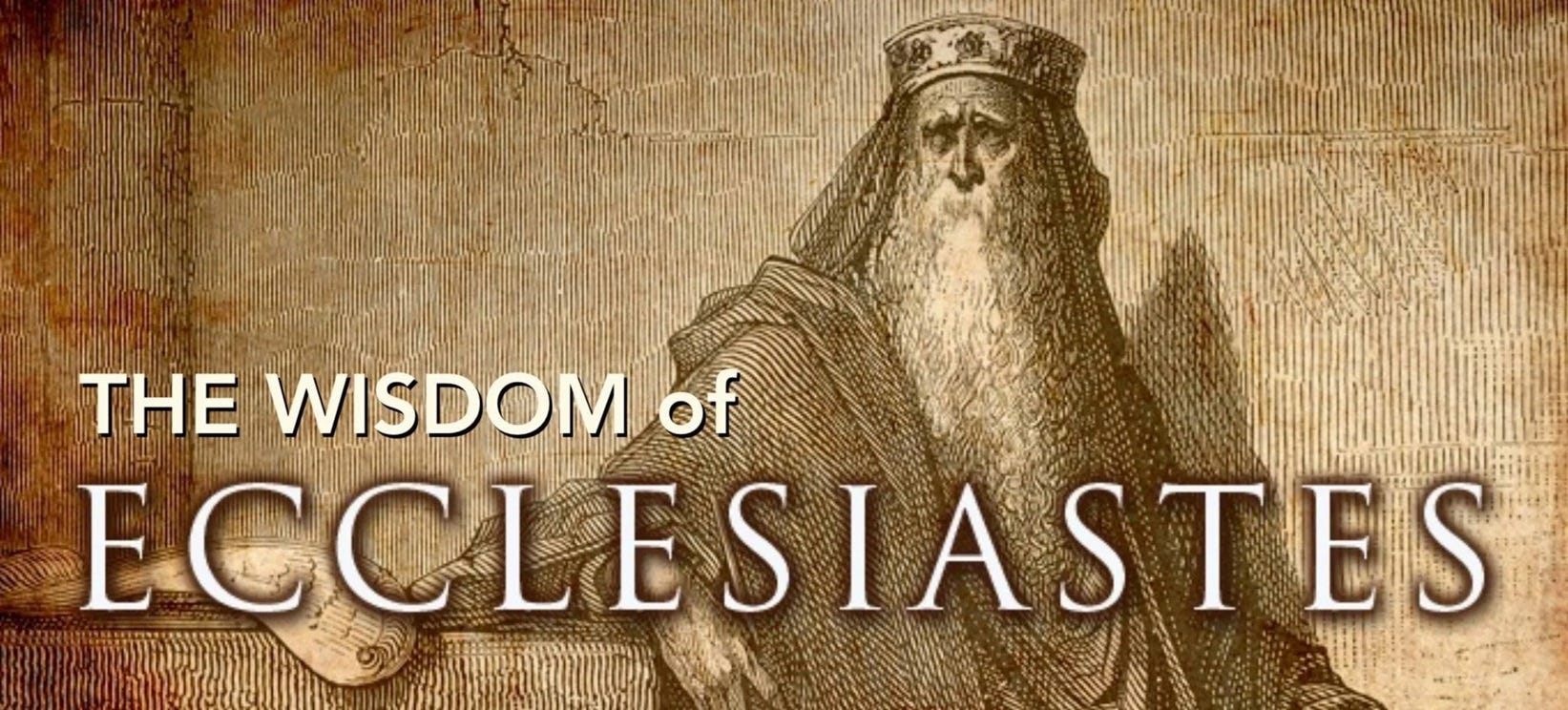
“He has made everything beautiful in its time. He has also set eternity in the human heart; yet no one can fathom what God has done from beginning to end” (ECC 3:11).
King Solomon has been cited as the wisest man to have ever lived, so I trust his advice.
His details listed in Scripture highlight that every human has an innate understanding that there is more to this life, that there is in fact an eternity. The Apostle Paul gives us some additional points to consider in Romans 1: 18-20 that “the godlessness and wickedness of people, who suppress the truth by their wickedness” and” For since the creation of the world God’s invisible qualities—his eternal power and divine nature—have been clearly seen, being understood from what has been made, so that people are without excuse.” Every human being is aware of eternity, but many suppress this divine fact.
This leads me to the second half of Solomon’s wisdom that “no one can fathom what God has done from the beginning to end.” Which begs the question, if Scripture clearly states no one can fathom, no human (not even King Solomon) can fully understand what God did at The Creation all the way through (His present sustaining power i.e. COL 1:17 “…and in him all things hold together”) to The End…why bother? All this chatter, research, theological bickering, even breaks in fellowship, why not just agree to disagree, throw the hands up and form the conclusion “it doesn’t matter”?
Because…it does matter.
The Beginning happened; Aristotle’s eternal universe model was wrong and even secular astrophysicists over the last one hundred years have come to the realization that there was a beginning (which they call The Big Bang). Some have veered off course into the realm of the multiverse model, but they freely admit there is zero empirical evidence to support the model which makes the idea philosophical more than anything scientific.
Even though we do not have all the answers, all the evidence, omniscience (all-knowing which only God is capable of), researchers and scientists do have pieces to the puzzle about the beginning. Christians have the additional and priceless resource of Scripture.
If Johannes Kepler would have taken the opinion in the 1700’s that Ecclesiastes 3:11 stated he would never fully be able to understand and demonstrate all parameters of the universe, we probably would have waited a long time to discover the laws of planetary motion. But Kepler not only studied the mathematics and the physics, but he saw the glory of God in the heavens. He attributed praise and worship to the Creator for the majesty above:
“Science is the process of thinking God’s thoughts after Him” (Brittanica).
“Ye heavens, sing His praises; sun, moon, and planets, glorify Him in your ineffable language! Praise Him, celestial harmonies, and all ye who can comprehend them! And thou, my soul, praise thy Creator! It is by Him and in Him that all exist” (Brittanica).
“The chief aim of all investigations of the external world should be to discover the rational order and harmony which has been imposed on it by God and which He revealed to us in the language of mathematics” (Brittanica).
Sir Isacc Newton, arguably the greatest scientist to have ever lived. He did not argue “that no one can fathom” so therefore we must do away with discovery. Two-thirds of Newton’s published works were on theology, the remainder on science and mathematics. He was deeply fascinated by the mind of God; the laws he would go on to demonstrate governed the universe.
He saw the orderly operation of the cosmos as evidence of divine design, with God as the ultimate “clockmaker” who established natural laws and initial conditions. This synthesis of empirical observation, mathematical reasoning, and theological reflection allowed Newton to reconcile science with faith while profoundly shaping the intellectual landscape of the Enlightenment (Philosophy Institute).
Newton sought out as much as he could about what was true, what was the actual state of things on Earth and in the abode of the heavens.
Psalm 19:1 is so often quoted that many can easily quote it “The Heavens declare the glory of God.” But when the student of Scripture reads a little further, much greater details are revealed (v1-4):
…the skies proclaim the work of his hands.
Day after day they pour forth speech;
night after night they reveal knowledge.
They have no speech, they use no words;
no sound is heard from them.
Yet their voice goes out into all the earth,
their words to the ends of the world.
“Day after day they pour forth speech, night after night they reveal knowledge.” There have been and will continue to be significant and marvelous revelations from the heavens. Ecclesiastes 3:11 reminds us that we are mere mortals, we can never truly understand it all. BUT in the meantime, this side of eternity, I would contend that we still have much to learn from God’s creation, from His heavens and that we should continue to develop our understanding of what the Lord has done. We will never fathom it all, it’s impossible, so let’s at least fathom together as much as we possibly can and be amazed by His power! May we “love the Lord your God with all of your heart and with all of your soul and with all of your strength and with all your mind” (Luke 10:27).
In a similar perspective, the Apostle Paul in his letter to the Ephesians addresses the depths of God’s love:
May have power, together with all the Lord’s holy people, to grasp how wide and long and high and deep is the love of Christ, and to know this love that surpasses knowledge—that you may be filled to the measure of all the fullness of God (v 18 &19).
Paul prays for all the saints throughout time, that we would be able to grasp how wide and long and high and deep is the love of Christ, but that it also surpasses knowledge. We can never humanly understand the full extent of Christ’s love (this side of Heaven); however, we can press on and with God’s help, we can seek to understand more and more of His great love (and strive to fathom His creative power).